Maker's marks, read off real pieces.
A stamp inside a drawer can tell you who built a piece, where, and roughly when. A missing one tells you something too. These are the marks I found on pieces I bought, what each one proved, and where I had to make a call.
Confirmed means the mark is on the piece, stamped or printed by the maker.
Inferred means it is my conclusion from the evidence. I say so every time.
Where I look first
- The inside of the top drawer, including the sides and the back of the drawer box.
- The back panel and the underside of the top.
- The hardware. Pulls and hinges are often stamped on the back or along the ring.
- Photograph every mark before you strip anything. Stripper lifts paper labels off with the old finish.
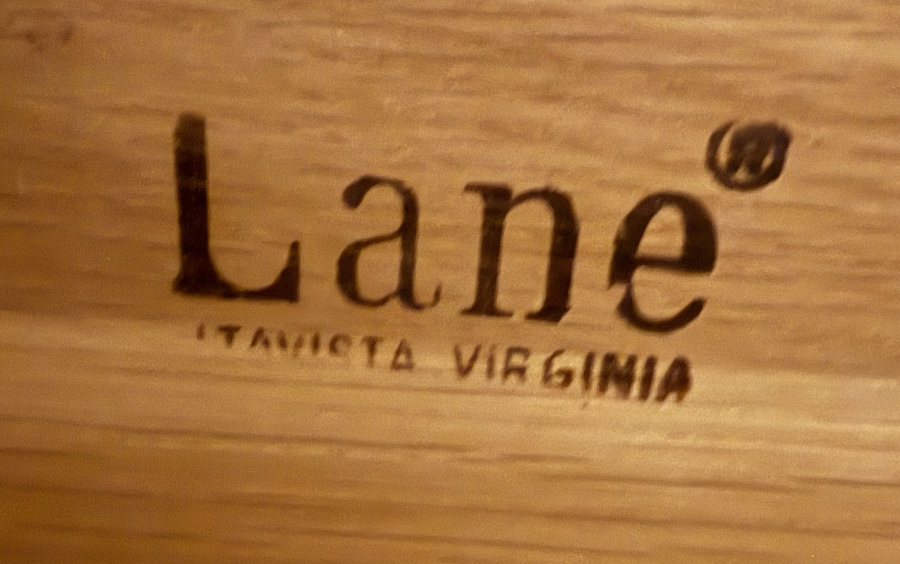
Lane
The word Lane in script, a registered trademark symbol, and Altavista, Virginia beneath it.
The makerConfirmed
The stamp says it outright. Lane started in 1912 in Altavista, Virginia, building cedar chests, and became The Lane Company in 1922.
The dateConfirmed
A manufacturer's stamp on the back of the dresser gives the date: December 1976. The drawer stamp names the maker, and the back stamp dates the piece.
What it changedConfirmed
The stamp named the maker. The oak under the dark splatter finish made it worth stripping.
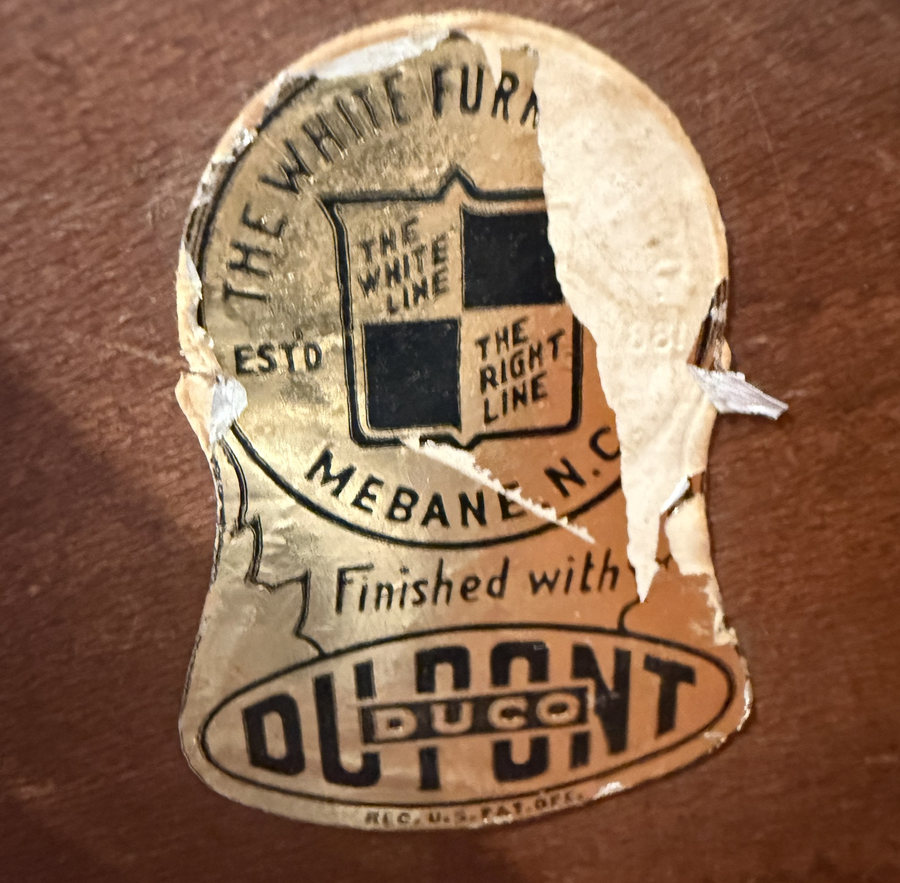
White Furniture Co.
The White Furn…, Mebane, N.C., a shield marked The White Line and The Right Line, and Finished with DuPont Duco.
The makerConfirmed
The company name, the town and the shield are still legible. White Furniture Company began in Mebane in 1881, started by brothers William E. and David A. White. Its inlay work became its trademark.
The dateInferred
The label has no year. A Duco lacquer label puts the table in the lacquer era: General Motors put Duco on its cars in 1924, and furniture makers moved almost entirely from shellac to lacquer between the late 1920s and the early 1930s. I call this table circa 1930. That is my estimate.
Why it survivedConfirmed
Paper labels last on the underside of a drawer because nobody cleans there. Strip a piece without photographing it first and the label goes with the finish.
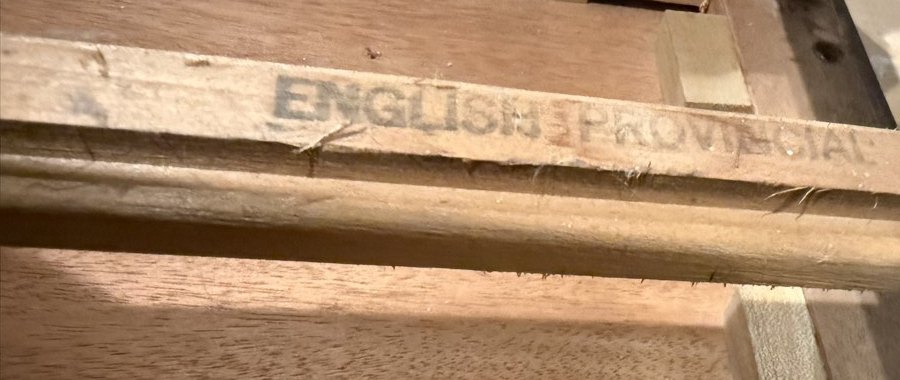
Baker
The stamp reads English Provincial. That is a style name. It does not name a maker.
The makerInferred
I believe this pair is Baker. The stamp fits Baker's 1960s and 1970s Provincial collections, and neither table had a Baker tag. That is my attribution from the stamp, the hardware and the construction, not a label I can show you.
The hardwareConfirmed
The brass ring pulls are stamped H 693 on one side and ABC on the other. That reads as a hardware supplier's mark. It narrows the field without naming the furniture maker.
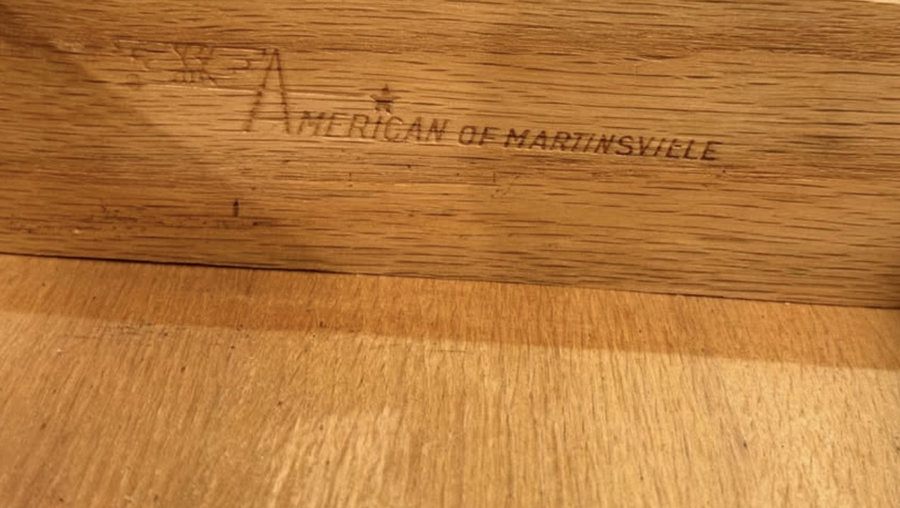
American of Martinsville
A winged emblem over a large A, a small star, and the name American of Martinsville.
The makerConfirmed
The company began in 1906 in Martinsville, Virginia, as the American Furniture Company, founded by tobacco businessmen Ancil Witten and Charles Keesee.
The dateInferred
By the 1950s the company was using the short name American of Martinsville, so I read this stamp as mid-century. A tag reading American Furniture Company would point earlier. Nothing on this stamp gives a year.
Why the drawer mattersConfirmed
The top is a wood-grain laminate, and that says nothing about who built the cart. The stamp inside the drawer did.
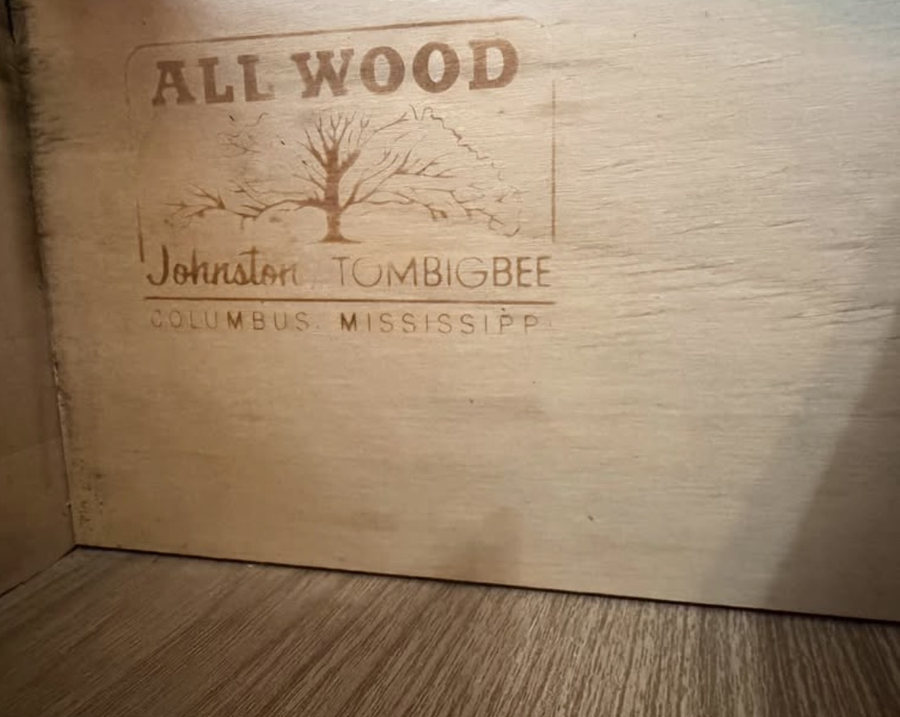
Johnston-Tombigbee
The words All Wood over a bare tree, then Johnston Tombigbee, Columbus, Mississippi.
The makerConfirmed
Johnston-Tombigbee, known as JTB, was a family-run company in Columbus, Mississippi, from 1932. In January 2026 it announced the Columbus factory would close that February.
All WoodMaker's claim
That line is the maker's own wording, not a guarantee. I check it against the joints. This dresser has dovetailed drawers.
The dateConfirmed
The logo stamp carries no year. A manufacturer's stamp on the back of the dresser gives it: 1984.
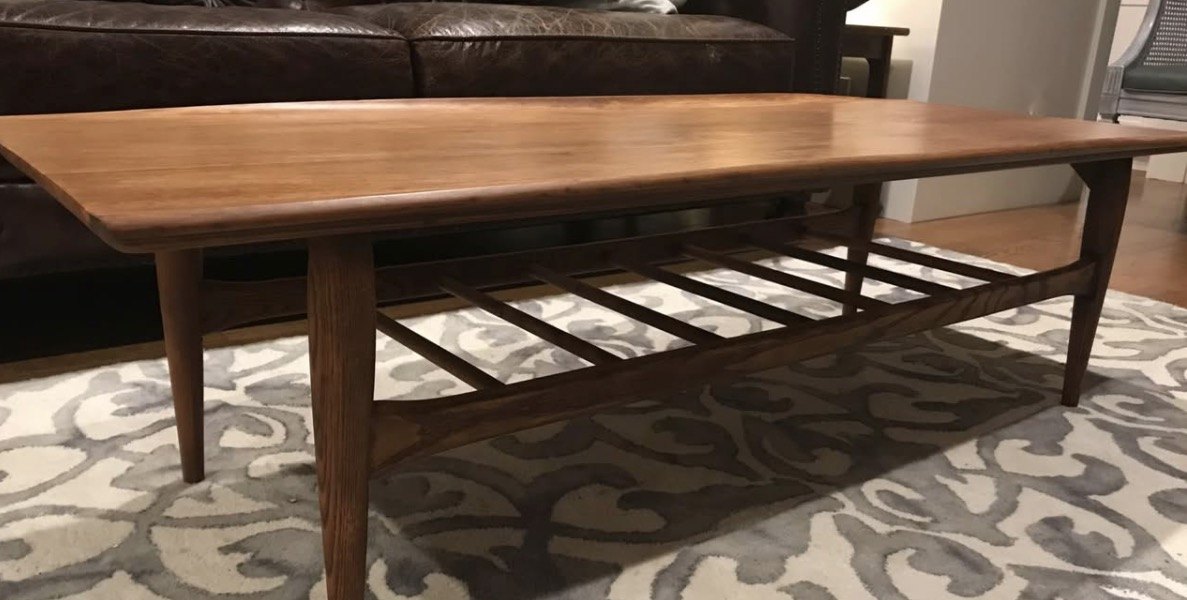
Bassett
A coffee table with nothing to read. No stamp, no label, no tag that I could find.
The makerInferred
I matched it by shape: a surfboard top with curved edges, a slatted shelf and tapered legs. The same family of tables appears in a Bassett ad I found online, where it appears under Bassett's Artisan group.
The dateInferred
I call this table early 1960s. The scan of that ad carries the caption LIFE magazine advertisement, April 7, 1961. One online comment says the line was introduced in 1962. The two do not agree, so the exact year cannot be confirmed.
The repairConfirmed
The top had water rings and one round slat was missing from the shelf. I refinished the top and replaced the slat.
What to do with no markMy method
Look at the shape, then search period ads and catalogs for the same silhouette. Then write down what you know and what you inferred, in separate columns.